
Rural fencing supply and installations right around Tasmania.
Ace Rural Fencing builds farm fencing, vermin exclusion fencing and gates for farmers and landowners across Tasmania.
Vermin & exclusion fencing
Keeps wallabies, rabbits, possums and deer off pasture, crops and new plantings, so what you put in the ground is still there next season.
- Wallaby netting with clipped or buried aprons
- Rabbit netting
- Deer fencing to 2.0 m
- Orchards, vineyards, plantings and revegetation
Farm fencing
Boundaries, paddock subdivision, laneways and yards, built to hold whatever you run. Sheep, cattle, horses or a mix of them.
- Ringlock and hinge-joint
- Plain, barbed and barbless wire
- Electric fencing, energisers and earthing
- Strainer assemblies, corners and ends
Gates & access
Gates sized to whatever has to get through, hung on a strainer assembly with hardware rated for the weight. Grids where stopping to open a gate is a nuisance.
- Galvanised farm gates, 2.4 m to 6 m
- Matched pairs for machinery
- Cattle and vehicle grids
- Repairs, re-straining and re-hanging
Vermin and exclusion fencing
Rabbits, wallabies, possums, deer. What we build comes down to which of those you’re dealing with.
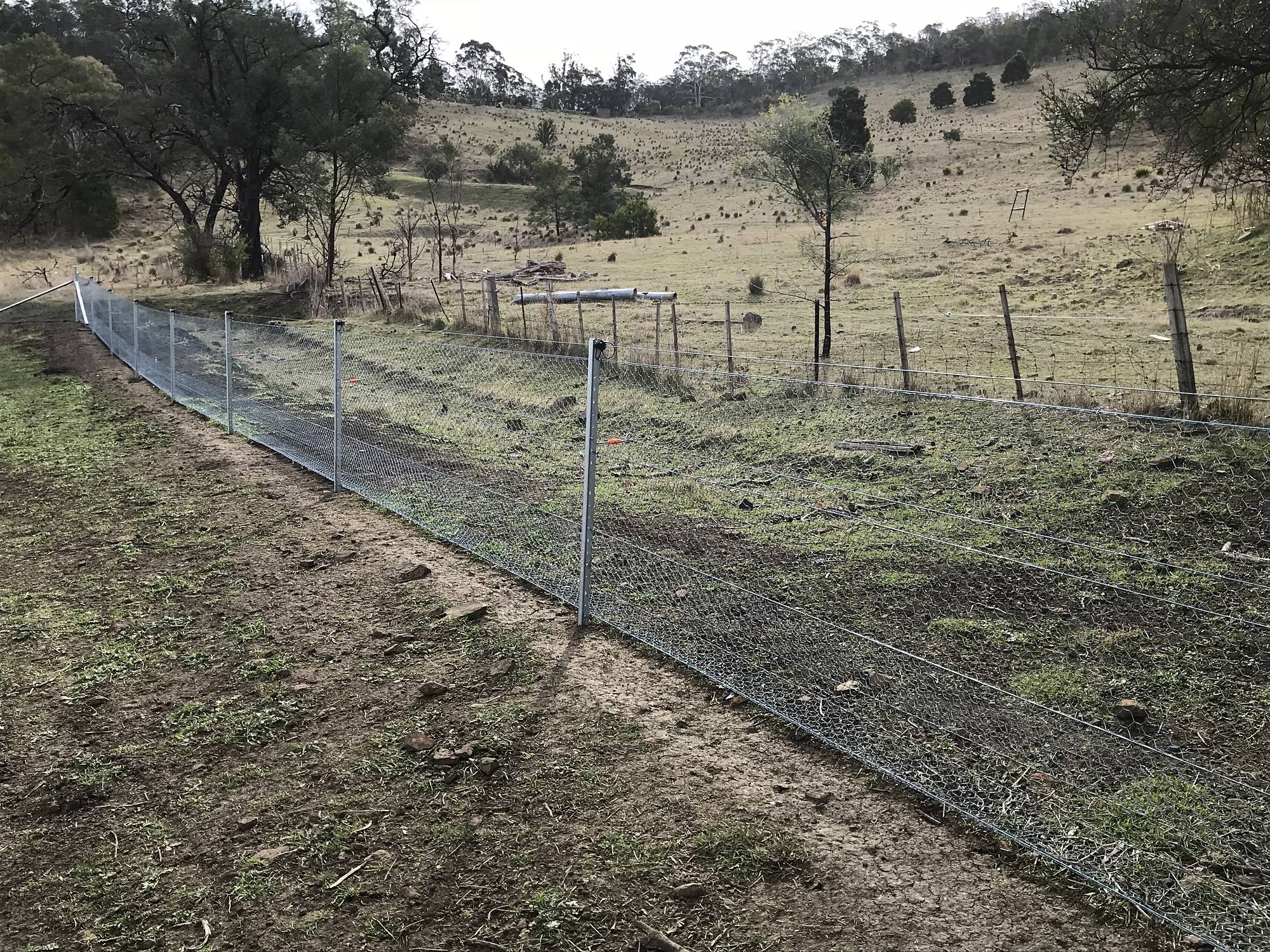
Rabbits and hares are a ground-level problem. They’ll dig long before they’ll climb, so the fence is fine mesh about 900 mm high, with the bottom either buried or laid flat as an apron on the side they’re coming from. If there are live warrens inside the line, they want dealing with first, or the fence just keeps them in there with your crop.
Wallabies need height on top of that. They can’t jump 1.15 m. Possums climb, so the mesh goes higher or gets a floppy top they can’t get a grip on. Fallow deer need the full two metres. Plenty of lines end up doing two jobs at once, with rabbit netting along the bottom of a wallaby fence.
Whatever’s out there will find the one spot that isn’t sealed, so the base of the fence and the ground under every gate get as much attention as the netting. Where the ground won’t take an apron, a live wire set 250 mm up does the job instead. Tell us what’s coming through and we’ll build for it.
- Pasture and crops
- Our longest runs, and the ones where the per-metre rate is at its best.
- Orchards and vineyards
- Netting the perimeter before planting is easier than working around established rows, and it takes the pressure off individual guards.
- Plantings and revegetation
- Landcare and forestry blocks, where rabbits do as much damage to a seedling as a wallaby does. Fenced as a block, with a gate wide enough for a tractor.
- House gardens and sheds
- Usually rabbits, in the vegetable garden or burrowing under the shed. Short runs with tight corners and a gate you use every day, so the hardware matters more than the metres do.
- Repairs to a line that’s already there
- Re-tensioning, re-pegging the apron and closing up the spots animals have found.
Farm fencing
Boundaries, paddock subdivision, laneways and yards. What you’re running decides how it gets built.
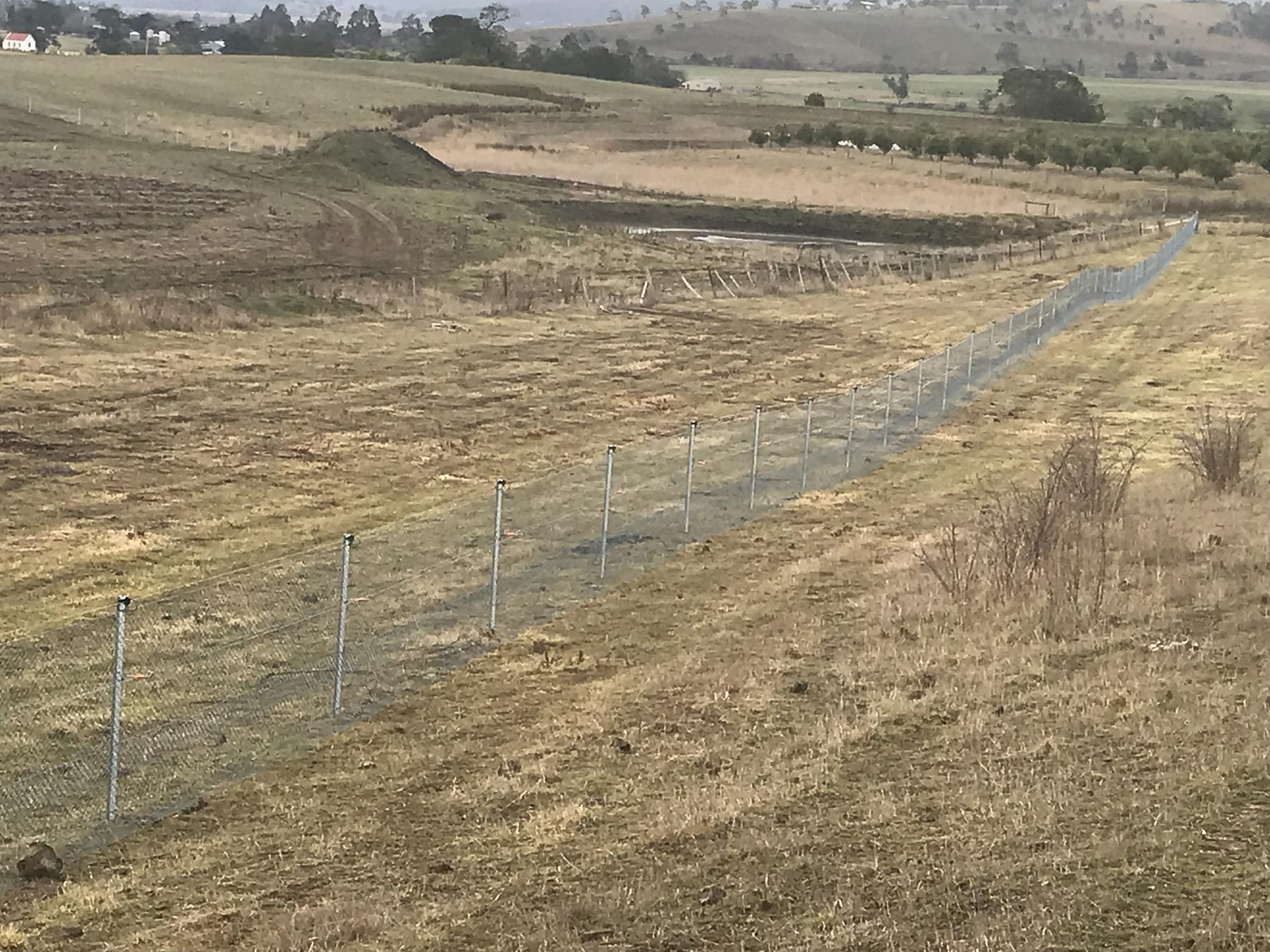
Lambs and goats will find any gap along the bottom, so those paddocks get mesh. Cattle lean on whatever’s in front of them, so the strainers and the wire tension do the work. Horses need something they can’t put a leg through. Most places run a mix, and the line changes as it goes.
The ends, corners and gateways are what hold a fence tight, and that’s where the hours go. Get those right and the line stays where you put it. They’re itemised on your quote, so you can see what the money’s doing.
Worth thinking about subdivision while we’re there. Splitting a big paddock costs less when the gear’s already on the property, and it’s usually the fencing that pays for itself first.
- Ringlock and hinge-joint
- Mesh for mixed stock and for anything with lambs in it, named by gauge and spacing on the quote so you know what you are getting.
- Plain, barbed and barbless wire
- Barbless where horses are, barbed where cattle push, plain wire above mesh to bring a fence up to height.
- Electric fencing
- Energiser, earthing and the wire itself, or an outrigger on a line that is already there to take the pressure off it.
- Strainers, corners and ends
- Set deep and braced for the pull they’re carrying. On a long run this is where most of the hours go.
- Laneways and yards
- Getting stock from one end of the place to the other without opening a gate every time, and holding them when they get there.
- Repairs and re-straining
- Re-straining a slack line, replacing strainers that have gone, and splicing in new sections where a fence has had enough.
Gates and access
The part of a fence you use every day, and the part that has to hold while the rest of the line pulls on it.
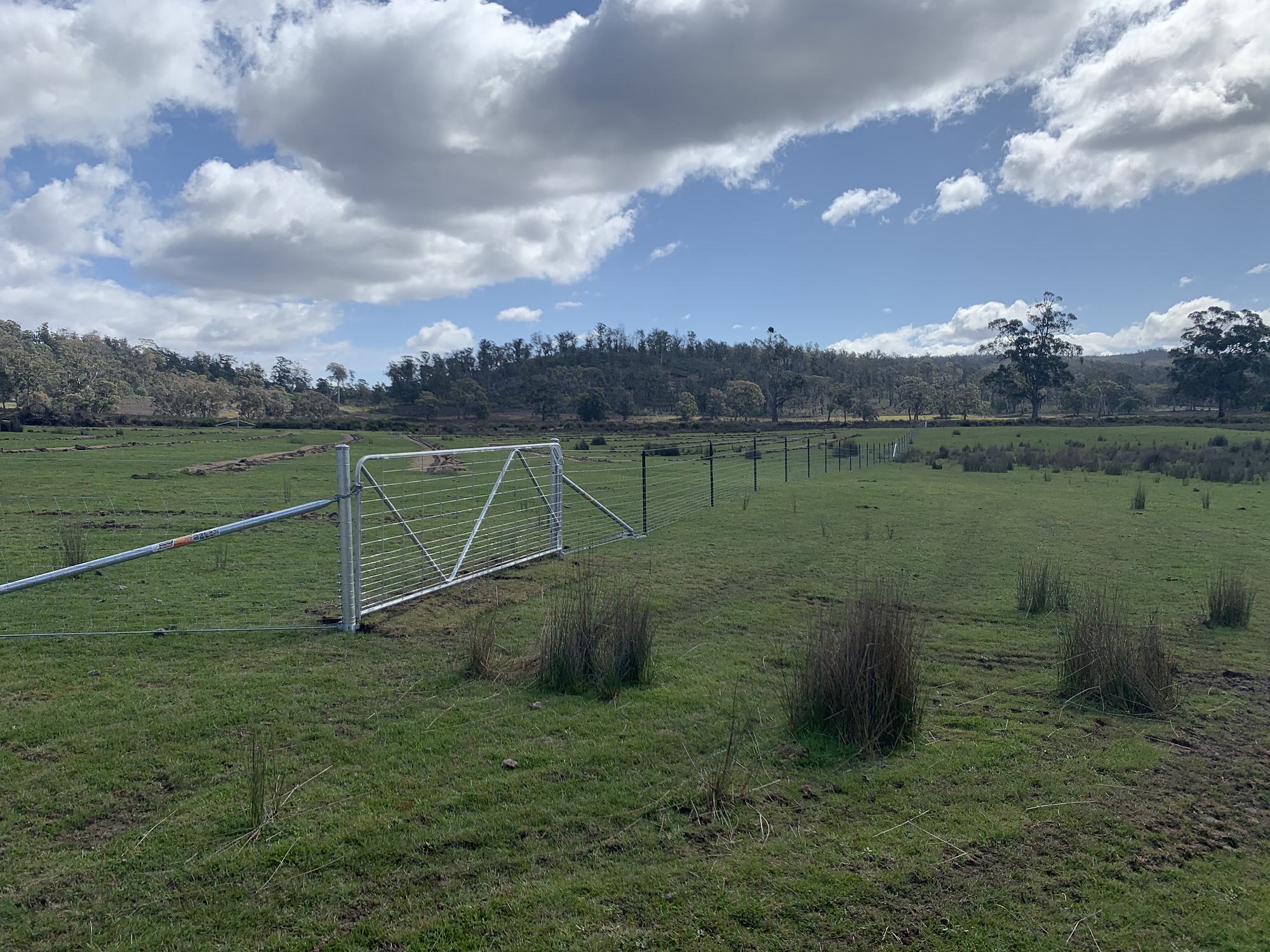
Measure the widest thing you own, then think about the thing you hire once a year. That’s the gate you want. Where a single gate would be long enough to start sagging, a matched pair spans the opening and either half opens on its own.
A gate is only as good as what it hangs on, so the assembly takes the weight of the gate and the pull of the fence either side of it. Hinges and latches are rated for the gate they’re carrying. That’s what stops it dropping and dragging in the mud a few winters on.
On an exclusion line the gateway is the first place anything tries. The ground under it gets levelled and hardened and the gate itself gets fine mesh, so the line holds the whole way round.
- Galvanised farm gates
- 2.4 m to 6 m, hung on hardware rated for the weight of the gate.
- Matched pairs
- For machinery openings and anywhere a single gate would be too long to hold its line.
- Cattle and vehicle grids
- Where stopping to open a gate is a nuisance, or where stock have learnt to work one open.
- Gates in an exclusion line
- Fine mesh on the gate and the ground under it closed up, so the gateway seals the same as the rest of the fence.
- Repairs and re-hanging
- Dropped gates, worn hinges and openings that have moved with the ground.
How it works
Enquire
Call or send us the details. Roughly how long the run is, what you’re keeping in or out, and what the country’s like. That’s usually enough for a per-metre range on the call.
Quote
A few photos and a dropped pin will do for a straightforward run. Anything with corners, gateways or old fence to pull out is better walked, and we’ll come to you. You get it in writing, itemised, with travel on its own line.
Materials
We settle what goes in with you: post type and spacing, mesh named by gauge, gate sizes. Where a lighter or a heavier option changes the price, you see both figures and it’s your call.
Build
Our own post driver and excavator go on site, so long runs and hard ground don’t hold the job up. We work around your stock movements, and when it’s finished we walk the line with you and give you a written record of what went in.
Fencing across Tasmania
Travel is in the quoted price. If you’re not near one of these districts, ask anyway.
North
Launceston, Longford, Perth, Evandale, Deloraine, Westbury, Scottsdale, George Town.
North-West
Devonport, Latrobe, Sheffield, Ulverstone, Burnie, Wynyard, Smithton, Circular Head.
Midlands & East
Campbell Town, Ross, Oatlands, Bothwell, Avoca, Swansea, Bicheno, St Helens.
South
Hobart, Richmond, Sorell, Brighton, New Norfolk, Huonville, Cygnet, Tasman Peninsula.
Frequently Asked Questions
Fencing is priced by the metre, and the rate depends on the fence itself. A long straight run through open paddock sits at the cheap end. It climbs when the line has corners and gateways in it, when the mesh and the post spacing need to be heavier, or when there’s scrub to clear or an old fence to pull out first. How far out you are counts as well, and travel goes on the quote as its own line so you can see it.
The rate per metre comes down as a run gets longer. Ends, corners and gateways are where the hours go, and once they are in, the straight metres between them go quickly. Ring and describe the job and you’ll get a range on the call.
A short run around a house garden or a young planting is a few days. A full boundary with gates, and aprons if it’s an exclusion line, can run to several weeks. Setting out takes longer than people expect once the country stops being flat.
The quote names the window we expect to start in, and you get a call the moment anything shifts.
It depends what you’ve got. Rabbits dig, so they need fine mesh with the bottom buried or aproned. Wallabies need 1.15 m of height on top of that. Possums climb, so the mesh goes higher or gets a floppy top. Fallow deer need the full two metres, in 17/190/15 netting on three-metre posts set a metre into the ground, and on some country an outrigger on both sides as well, because stags push at a fence and can get their antlers caught in it.
Yes. A fair bit of our work is exactly that. On a side slope the post spacing follows the contour so the base of the fence stays tight to the ground, and on an exclusion line that’s the detail that matters most.
Rocky country is slower going and it holds a fence better than anything once the posts are set, because it’s hard for a wombat to dig.
Both, if you want them done. Clearing a line through scrub counts as part of the fencing cost under the Boundary Fences Act 1908, generally two metres either side. Old fence coming out goes on the quote as its own line. That way you can see it.
Usually, and it all appears itemised on the quote so you can price it yourself if you want to. If you’d rather buy your own we’ll quote labour instead. Where we think what you’ve got on hand won’t do the job you’ve described, we’ll say so and note it.
Often, yes. The Boundary Fences Act 1908 sets out how adjoining owners share the cost of a dividing fence, and there’s a notice to serve in writing before any work starts. What that notice has to say, how long it runs, and which boundaries are exempt are all in the Act. Legal Aid Tasmania publish a guide to it in plain English.
Get your own advice before you serve anything on anyone. What we can give you is a written, itemised quote your neighbour can look at, so the conversation starts from a real number.
Tell us about the job.
Send through what you know. A rough length and a photo or two is plenty to come back to you with a range.
-
Phone 0400 590 660